Fingers rest on the hoods at the base of Pinnacle Mountain. The climb is already talking. Eight to eleven percent gradient pitches stack above the lot, and the next shift will either seat the chain or let it chatter through an upward of 400-watt out-of-the-saddle surge.
A mechanical drivetrain answers with a clunk you can feel in the palm. Electronic systems answer with a click so light it almost vanishes into the bar tape.
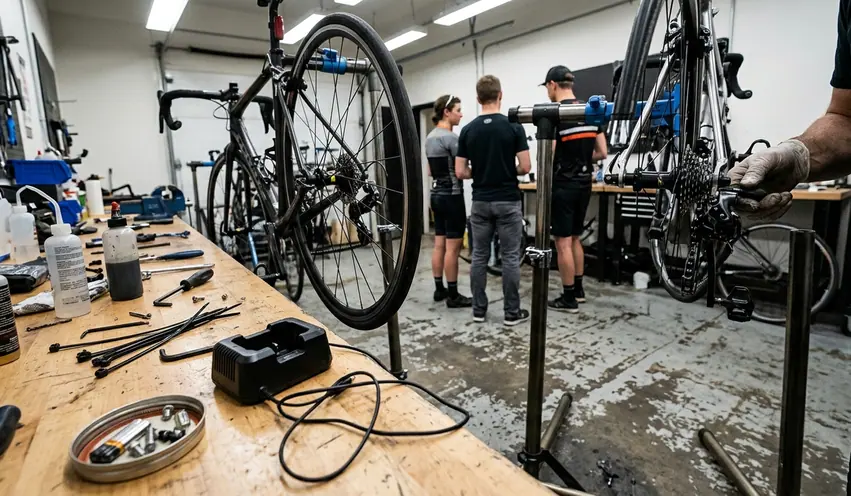
SRAM AXS and Shimano Di2 dominate the electronic drivetrain conversation on Tuesday-night local rides. Both move a chain under load. They do it with different radios, different batteries, and different tempers when the grade steepens.
In this Article
- The Starting Line: Tension at the Base of the Climb
- Team Lineups: Fully Wireless vs. Semi-Wireless Architecture
- First Half Action: The Installation and Setup Phase
- Second Half Surge: Shifting Speed and Under-Load Precision
- Extra Time: Battery Endurance and App Customization
- The Final Whistle: A Step-by-Step Giant TCR Upgrade Blueprint
The Starting Line: Tension at the Base of the Climb
On the Pinnacle Mountain approach, the 11-percent pitch is where shifter feel stops being a catalog line. Riders still running cables describe a delayed bite, a beat when the lever has moved and the derailleur has not. Riders on AXS or Di2 describe an immediate, dry click and a chain that is already climbing the cassette.
That tactile gap is the whole argument in miniature.
Shared miles on local routes make the difference obvious. A women's cycling group rolling out from Two Rivers Park hits the same false flats, the same traffic windows, the same need for a clean downshift before a surge. Training plans that call for seated threshold work still dump people onto that 11-percent pitch eventually. When they do, the shifter in the hand is the only interface that matters.
Practice the shift before the steepest pitch, not on it. Electronic systems reward a pre-load click while wattage is still climbing. Waiting until the surge has already started asks the front derailleur to shove a chain that is already under tension.
The chain is already on the next cog before the click has faded from the hoods.
Carry that habit onto the Arkansas River Trail and the same logic holds on rollers. Click early. Let the motor work while the legs are still organized. Save the panic dump for a true sprint, not for a grade that was visible from the parking lot.
Team Lineups: Fully Wireless vs. Semi-Wireless Architecture
Which system is actually wireless? That is the question that shows up in shop conversations whenever a new groupset drops.
SRAM's Radio Mesh
SRAM AXS runs a fully wireless ecosystem. Derailleurs wear interchangeable batteries. Shifters hide CR2032 coin cells that last 24 to 30 months. No wire leaves the bar. No wire enters the frame. The radio mesh is the product.
Swap a battery the way you swap a bottle. Pull the pack off the rear derailleur, click a charged pack in, keep riding. The front derailleur uses the same pack shape, which is the roadside insurance policy baked into the design.
Shimano's Wired Spine
Shimano Di2 runs a semi-wireless design. The shifters talk over the air to a junction. A roughly 7.4-volt lithium-ion central power unit lives inside the frame or seatpost and feeds both derailleurs through internal wires. The wireless piece stops at the bar. Everything that actually moves a cage is on a wired spine.
Charge that one cell and the whole drivetrain wakes up. Nick a wire in the chainstay and both derailleurs go quiet together. The architecture concentrates risk and convenience in the same place.
Those structural choices set the maintenance calendar. A fully wireless bike strips into a travel case without fishing cables. A semi-wireless bike wants a charging appointment and a mechanic who is willing to open the seatpost. Riders building winter training plans around indoor miles plus weekend local routes should pick the habit that matches how the bike actually gets used: frequent small charges, or one long charge and a long forget.
Roadside Battery Trade
If the rear AXS pack dies on a remote stretch of the River Trail, pull the front derailleur battery and click it onto the rear unit. The bike will still get home in the little ring. Di2 has no equivalent field swap; the central cell is the whole conversation.
First Half Action: The Installation and Setup Phase
Beginners staring at a first electronic groupset usually want a straight answer about the garage session. How long. How many hex keys. How much bar tape on the floor.
Bolt-On Wireless
SRAM posts an early score. Bolt the derailleurs on, install the shifters, pair, ride. Fully wireless component mounting can land well under an hour on a standard road frame. Zero frame routing. Zero bar-tape fishing if the old mechanical cables are already out. Home mechanics who have never touched a Di2 junction box can finish in a single garage session.
Wires Through the Seatpost
Shimano asks for more patience. Wires have to thread the frame and seatpost. Semi-wireless internal frame routing takes a longer garage session for a careful home mechanic. The work is methodical rather than mysterious, but it is work: ferrules, internal magnets, a battery that has to sit true in the post, a junction that has to hide without rattling.
Those installation estimates assume a standard two-piece bar and stem configuration. Routing semi-wireless systems through fully integrated carbon cockpits often adds substantial labor. Anyone staring at a new TCR Advanced SL cockpit and matching the garage clock to a short video will miss that difference. The extra hours live in the headset and the one-piece bar, not in the derailleur.
Cockpit Routing Tax
A two-piece bar and stem keeps Di2 routing manageable. A fully integrated carbon cockpit can turn the same job into a multi-hour project. Decide the cockpit before you decide the groupset, or budget a shop day you did not plan.
Once the wires are in, leave a service loop at the bottom bracket. Future battery swaps and crash inspections go faster when the first person to open the bike already knows where the slack lives. That is the advanced move after the beginner win of simply finishing the install.
Second Half Surge: Shifting Speed and Under-Load Precision
Shimano answers the install deficit on the road. Front derailleur speed is the headline, and it shows up the first time a rider stands on an 11-percent pitch and asks the chain to climb.
Di2 executes an over-shift and micro-correction sequence that completes within fractions of a pedal stroke. Under heavy torque during hard sprints, that aggression keeps the chain from climbing the big ring and then falling off the other side. The cage overshoots on purpose, seats the chain, then settles. You feel a shove, then silence.
SRAM counters with sequential shifting logic and a rear derailleur that moves like it is on rails. Hold the paddle and the cassette dumps several cogs in a row. The rear unit stays calm when the rider is out of the saddle and the bike is rocking across the crown of the road. Multi-shift is the AXS signature, and it earns that reputation on rolling local routes where cadence has to jump in a hurry.
Performance under heavy pedaling load during those out-of-the-saddle sprints is where the systems split. Di2's front end snaps. AXS's rear end flows. Riders who live in the little ring on the River Trail rollers will feel SRAM more often. Riders who smash the big ring on short Pinnacle-style pitches will feel Shimano more often.
Keep the cassette and chainrings clean enough that the motor is moving a chain, not a grit paste. Electronic shifting has a simple contract with the rider: the system will shift under load if the drivetrain is free enough to accept the motor's shove. Mud packed into a pulley cage breaks that contract faster than any firmware setting.
Extra Time: Battery Endurance and App Customization
Endurance is where the architectures diverge again, and where charging habits start to look like training plans.
Shimano's central battery covers 1,000 to 1,500 kilometers per charge. Months of riding between plug-ins is a real pattern for commuters and weekend riders who share the Arkansas River Trail. SRAM's modular derailleur batteries deliver 40 to 60 hours of ride time each. The modular trick remains the roadside swap described above: a dead rear pack trades places with the front derailleur pack so the rider still gets home.
Companion apps decide how the hands talk to the motors. E-Tube and AXS both let riders map shift buttons for personalized ergonomics. Sprint shifters, satellite buttons, and inverted sequential logic all live in those menus. Women's cycling fits and smaller hands benefit here as much as anyone: move the most-used shift under the strongest thumb and stop stretching for a paddle that was designed around a different palm.
Battery status sits in the phone app next to the bike profile.
Map The Strong Thumb
Open E-Tube or AXS before the next group ride. Put the shift you use on every roller under the thumb that already holds the hood. Leave the panic dump on a button that cannot be bumped in a sprint. That mapping is free speed.
References
The Final Whistle: A Step-by-Step Giant TCR Upgrade Blueprint
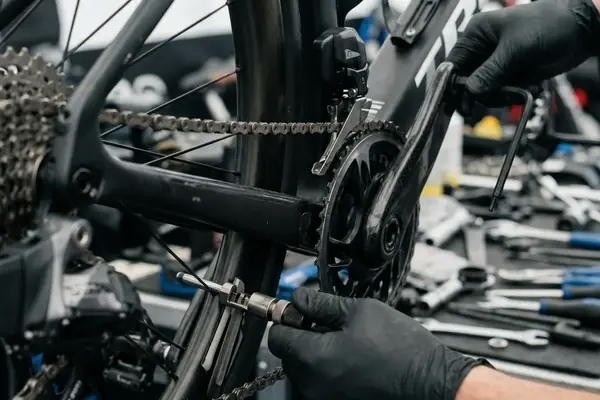
Copy this case. A mechanical Giant TCR Advanced converted to SRAM Rival eTap AXS, then shaken down on home pavement.
Pull the Cables
- Shift the mechanical drivetrain into the small ring and the smallest cog so the derailleurs sit relaxed.
- Cut the old cables at the bar, pull housing through the frame, and discard ferrules and noodle guides.
- Bolt the wireless rear derailleur onto the hanger. Torque the mounting bolt to the hanger's spec, then install the battery.
- Bolt the front derailleur to the braze-on. Set cage height just clear of the big ring teeth, then install its battery.
- Mount the shifters. Wrap fresh tape. Charge both derailleur batteries fully before the first pairing attempt.
Pair and Micro-Adjust
- Pair the shifters to the rear derailleur using the single-button press sequence in the official SRAM AXS pairing protocols.
- Assign the left shifter to the front derailleur with the same single-button press. Confirm both batteries show a healthy charge in the AXS app.
- Micro-adjust the rear unit. AXS offers inboard and outboard micro-adjustment steps of about 0.25mm. Center the pulley under the cog, then tap one step at a time until the chain runs silent in the hardest and easiest gears.
- Repeat for the front derailleur so the cage clears the big ring without rubbing the small. Use the same step size. Stop the moment the rub disappears; extra steps walk the cage into the tire or the crank.
- Ride a 14-mile loop on the Arkansas River Trail. Shift under seated power first. Stand and hit a short surge. Listen for chain slap. If a single step still leaves a whisper of rub, take one more inboard step and ride the loop again.
When the drivetrain stays quiet through that full 14-mile loop, the mechanical Giant TCR Advanced is done becoming a wireless bike. Park it, top both batteries, and take the same sequence to Pinnacle the next morning: click before the 11-percent pitch, stand when you mean it, and let the motors finish the shift you already asked for.