Holding River Trail Fitness Through an Arkansas Winter
How do you maintain peak summer cycling fitness when cold, wet Arkansas weather forces the bike indoors?
That question becomes urgent in late December, when average temperatures in Little Rock drop into the mid-30s Fahrenheit and sunset arrives before 5:15 PM. A post-work ride on the River Trail quickly turns into a contest against darkness, slick pavement, and cold hands. Riders who spent months building endurance on local routes can feel those gains slipping away.
The trainer solves the access problem. Structure solves the fitness problem.
Aimless spinning rarely creates enough progression to sustain motivation or produce a useful training response. It usually settles into a moderate effort: too demanding for recovery, too comfortable for meaningful adaptation. Give every indoor minute a job instead. Warm up with intent, complete a defined main set, and cool down against a measurable endpoint.
Winter’s Real Target
Preserve aerobic durability, maintain leg speed, and arrive in spring ready to add volume. Chasing peak race form throughout winter creates fatigue at the wrong point in the calendar.
This approach also makes training plans easier to follow around work and family obligations. One focused hour has clear boundaries. You know when the hard work begins, what success looks like, and when to stop.
Building a Trainer Setup That Handles Heat
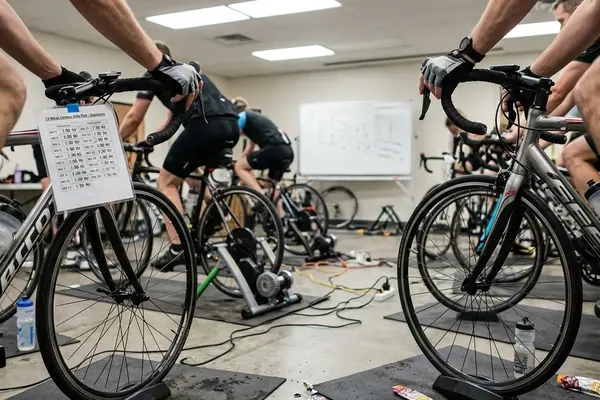
A reliable smart trainer offers the simplest route to controlled resistance and repeatable power targets. A fluid trainer paired with speed sensors can also work well. Before mounting a Giant or Liv road bike, confirm axle compatibility, install the correct adapters, and check that the bike sits level.
Cooling deserves equal attention. Indoor riding removes the airflow that carries heat and moisture away outdoors, so sweat accumulates even when the room feels cool.
I initially tried standard oscillating room fans and abandoned them because the broad, intermittent airflow failed to evaporate sweat efficiently. A high-velocity industrial floor blower produced a much better result.
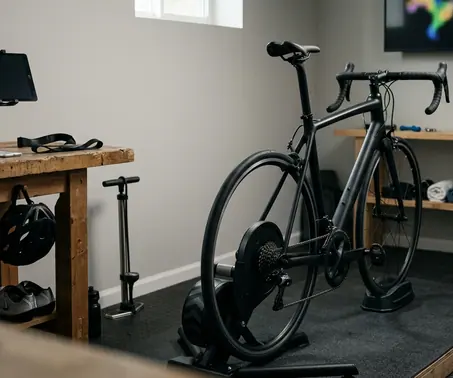
Place a floor blower capable of pushing at least 2,000 cubic feet per minute directly toward the torso. Aim it across the chest and shoulders rather than at the front wheel. Turn it on before the warm-up; waiting until sweat pours off the rider means heat has already started shaping the session.
Keep one full 24-ounce bottle within easy reach. An electrolyte mix containing 300 to 420 milligrams of sodium provides a practical replacement range for indoor sweat losses. Put the bottle where it can be reached without twisting or looking down.
- Trainer: Smart or fluid resistance unit with the correct axle hardware.
- Airflow: High-velocity floor blower aimed at the upper body.
- Hydration: Filled electrolyte bottle beside the bars.
- Protection: Towel over the top tube and a mat beneath the bike.
- Controls: Workout display or timer visible from the riding position.
Giving Every Minute of a 60-Minute Ride a Job
“Junk miles” become especially expensive indoors. The scenery does not change, the bike never coasts through a corner, and a vague moderate pace adds fatigue without addressing a specific limiter.
Minutes 0–12: Raise Cadence Gradually
Start in an easy gear near 85 rpm. Over a 12-minute window, increase cadence progressively toward 100 rpm while keeping resistance controlled. This sequence raises tissue temperature, moves the joints through their working range, and prepares the nervous system for faster contractions.
A warm-up should feel increasingly alert rather than increasingly strained. Save the pressure for the main set.
Minutes 12–48: Execute One Main Set
Use roughly 35 to 40 minutes for the day’s defined work, including recovery periods between intervals. Sweet spot work develops durable aerobic power. Short VO2 max repetitions sharpen the punch needed for rolling Arkansas hills. Mixing unrelated targets in the same hour usually weakens both.
Minutes 48–60: Bring the System Down
Reduce resistance and spin easily. Dismount once heart rate has fallen below 115 bpm rather than stepping off immediately after the final effort. The gradual reduction gives breathing, circulation, and coordination time to settle.
Scope of the Hour
This 60-minute framework serves off-season maintenance and base building. Riders preparing to peak for early spring criteriums will need longer main sets and dedicated anaerobic-capacity intervals.
For a 60-minute off-season base-building session on Giant and Liv setups, this division provides the starting structure: 12 minutes to prepare, about 36 minutes to train, and 12 minutes to cool down.
Scheduling Three Winter Sessions Around Recovery
Three structured indoor sessions totaling 180 minutes per week create enough repetition to preserve fitness while leaving room for recovery. Place a rest or easy day between demanding rides, and maintain at least 48 hours between high-intensity VO2 max sessions.
Day 1: Sweet Spot Durability
Complete three blocks of eight minutes at 88 to 92 percent of Functional Threshold Power. Spin easily for four minutes between blocks. The effort should feel challenging and controlled, with stable posture and no desperate surge during the final minute.
These intervals build aerobic support without the recovery cost of repeated maximal work. Riders without dependable power measurement can use a steady effort that allows only short phrases while preserving the same output across all three blocks.
Day 2: Two-Minute VO2 Max Repetitions
Ride five sets of two minutes at 110 to 115 percent of FTP, followed by two minutes of complete easy recovery. Each work interval lasts exactly 120 seconds. Resist the urge to attack the opening repetition; an even fifth interval matters more than an explosive first one.
This is the punchy session. It supports the repeated accelerations demanded by short rises and rolling terrain rather than turning the entire week into a race simulation.
Day 3: High-Cadence Recovery
Keep the primary recovery block to 45 minutes of very light pedaling. Hold cadence between 95 and 105 rpm while capping resistance under 55 percent of FTP. Use the remaining scheduled time for an easy ramp into and out of that block, with zero high-intensity efforts.
- Finish the session feeling looser than when it began.
- Keep breathing conversational throughout.
- Reduce resistance before allowing cadence to fall.
- Skip surges, sprints, and virtual finish-line contests.
The resulting Little Rock winter microcycle follows a practical FTP interval breakdown: aerobic pressure, high-intensity power, then circulation-focused recovery.
Protecting Posture and Catching Fatigue Early
A stationary bike magnifies small position errors because outdoor movement disappears. Keep a light grip on the bars, soften the elbows, and let the shoulders sit away from the ears. Check hand pressure whenever an interval becomes difficult; riders often brace through the upper body while trying to create power at the pedals.
Stand out of the saddle for exactly 30 seconds every 10 minutes. Use moderate resistance and a controlled gear so the bike remains stable. These short standing intervals relieve perineal pressure, recruit stabilizing muscles, and restore some of the movement found during outdoor riding.
Reading Productive Fatigue
Heavy legs after sweet spot work can be expected. A persistent change in resting heart rate deserves closer attention. An elevation of 5 to 7 beats per minute above a three-day rolling average serves as a useful indicator of accumulated fatigue, especially when paired with poor sleep, unusual irritability, or an inability to raise heart rate normally during intervals.
Take the extra rest day when those signs cluster. Replacing a hard ride with easy movement protects the next quality session and keeps the week coherent.
Form Before Power
End an interval when posture breaks repeatedly. FTP targets only help when the rider can produce them with stable hips, relaxed shoulders, and controlled breathing.
Winter burnout often starts with too many competitive sessions disguised as routine workouts. Virtual racing adds tactical surges and emotional pressure, so count it as a high-intensity day rather than casual entertainment.
Choose Consistency Over Daily Intensity
The golden rule for winter training is simple: consistency always beats intensity.
Daily virtual races can deliver impressive individual files while quietly eroding the desire to train. They compress recovery, encourage repeated maximal efforts, and turn every ride into a test. Spring fitness grows more reliably from repeatable weeks.
Protect three focused trainer sessions: one sweet spot day, one VO2 max day, and one active recovery day. Execute each session as written, keep 48 hours between VO2 max workouts, and leave enough energy to return the following week.
Commit to those three structured hours every winter week and refuse the daily race invitation.