Can One Carbon Gravel Frame Survive Ozark Washboards and Little Rock Commutes?
Can a single mid-tier carbon gravel bike truly handle four-hour Ozark forestry-road washboard grinds on Saturday and still make sense on potholed Little Rock commuter asphalt on Monday?
I logged 4,120 miles across 22 months to answer that question: 1,650 miles on unpaved forestry roads around Lake Sylvia and 2,470 on central Arkansas chip-seal and river trail asphalt. The routine paired weekend backcountry loops with three paved commutes each week, carrying a 172-pound rider through wet limestone crossings and gritty winter streets.
The Giant Revolt Advanced earned its place through the interaction of tires, seated compliance, and rear-end geometry. Its geometry chart gives you the dimensions; pushing beyond the factory tire setup reveals the personality.
Tubeless pressures ranged from 31 PSI on wet limestone to 42 PSI on commuter pavement. Those changes matter when interpreting the ride: neither comfort nor grip belongs to the frame alone. This test also describes rocky, fast-draining Arkansas terrain, rather than sticky clay or aero gravel racing.
For similar local routes, check the Ouachita National Forest motor vehicle use maps when planning forestry-road access.
Where D-Fuse Helps, and Why the Flip Chip Stayed Long
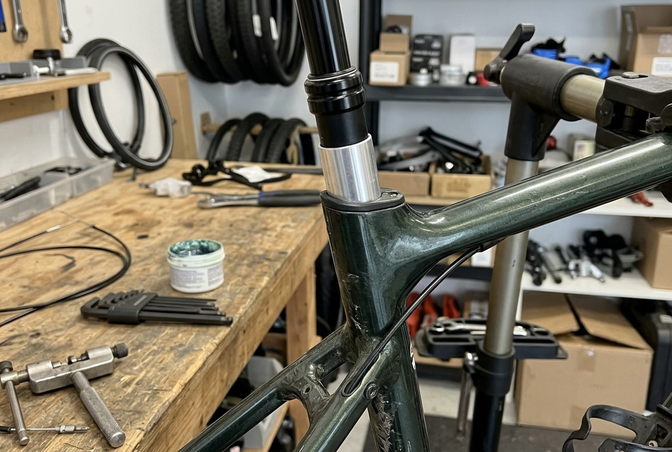
Start with the seated experience. On coarse chip-seal, the D-shaped carbon D-Fuse seatpost gives the saddle room to move rearward under load, taking some sharpness out of the repeated impacts reaching your lower back. Its stated design allowance reaches up to 12mm under peak vertical loading; that figure describes available flex, not measured travel on every bump.
The handlebar contributes another compliant contact point. Separating its contribution from tire deformation and seatpost movement would require controlled measurements, so the useful field conclusion concerns the whole system: seated chatter absorption stands out more clearly than any isolated component.
Concerned about proprietary hardware? The frame also accepts a standard 30.9mm round post through its adapter arrangement, including a compatible dropper. That opens a practical progression toward rougher riding, although changing posts also changes the particular compliance delivered by D-Fuse.
The rear dropout adjustment makes a more straightforward comparison. Short means 425mm chainstays and maximum rear tire clearance of 45mm. Long extends the chainstays to 435mm and clearance to 53mm. These are chainstay dimensions, rather than complete wheelbase measurements.
Alternating positions through the first 11 weeks exposed the trade: short felt livelier on pavement and tight levees; long settled the bike on loose washboard descents. At week 12, near the end of month three, the chip stayed long. For this mix of riding, predictable descending outweighed the small loss of pavement snap.
What Sharp Chert Exposed in the Factory Build
The first decisive replacement arrived at mile 310. Sharp Ouachita chert opened a 9mm sidewall slash in a factory 38mm tubeless tire, ending that casing’s test in week five.
Reinforced 45mm casings went on immediately and completed more than 3,800 subsequent miles without another recorded tire problem. That comparison favors casing protection for these roads, though width, construction, pressure, and route exposure changed together. Wet limestone still demanded careful line choice; extra casing strength cannot manufacture traction.
Bearings, Tape, and the Saddle Decision
Every 1,000 miles, teardown and bearing inspection checked what silica dust, winter spray, and low-water crossings had left behind. The press-fit bottom bracket reached mile 2,840 before developing gritty bearing drag, after 14 submerged creek crossings. The log records that wear point but no corresponding wheel-bearing failure.
The factory 2.5mm bar tape lasted to mile 1,100, when 3.2mm high-density elastomer wrap replaced it. That change addressed the hand contact directly, complementing the frame’s seated compliance.
Saddle choice deserves its own fit assessment. The log does not document a saddle replacement, so attributing an endurance breakthrough to one would overstate the evidence. Check support and pressure over a full ride before buying a substitute.
Log Before Upgrading
Record the mileage, symptom, and reason for each replacement. Across this 22-month evaluation, wear and damage drove the documented swaps rather than weight-saving upgrades. That distinction is what makes a long-term bike review worth reading.
Why Sprint Specialists and Heavy Expedition Riders Should Pass
The Revolt’s comfortable front end asks something back when the pace turns aggressive. Across six consecutive Tuesday fast pacelines on the Arkansas River Trail, 32mm slicks helped examine its road manners. Standing efforts above 800 watts and 26 mph exposed noticeable lateral movement through the flared alloy bar and steerer assembly compared with dedicated endurance road frames.
Riders seeking a stiff, race-first aero gravel bike should take that distinction seriously. For road-dominated training plans and repeated sprint efforts, an endurance road frame makes the cleaner comparison.
Heavy expedition packing presents a separate constraint: the carbon fork mounts carry a maximum of 3.5 kilograms per side. Build the luggage plan around that limit before committing to front panniers.
For the mixed-surface rider, picture Tuesday at dusk: rolling off the Big Dam Bridge, gray Perry County gravel dust still clinging to the tires from the weekend. A sunken expansion joint passes beneath the wheels; the saddle gives slightly, hands stay settled, and the ride home continues.